Your suppliers are consolidating. Here's who keeps the savings.
I've had a few owners ask me what the run of supplier mergers means for their shop. Repairify just combined its diagnostics business with Opus IVS. In paint, Axalta and AkzoNobel are working on their own combination. The quiet hope underneath the question is usually the same. If my suppliers are getting bigger and more efficient, does my price come down?
It's a fair question, and the answer runs through how a merger actually changes the money. Let me walk that first, then get to the part that decides whether any of it reaches you.
What a merger actually does
Round, conservative numbers, so the mechanic is easy to see.
Want insights like this in your inbox?
Subscribe to the Collision Advisory newsletter. Financial strategy and industry analysis for collision repair operators, delivered weekly.
Take two suppliers about the same size. Each does 100 in revenue, 85 in cost, and 15 in profit. Put them together and change nothing, and you have 200 in revenue, 170 in cost, 30 in profit. Nothing has happened yet.
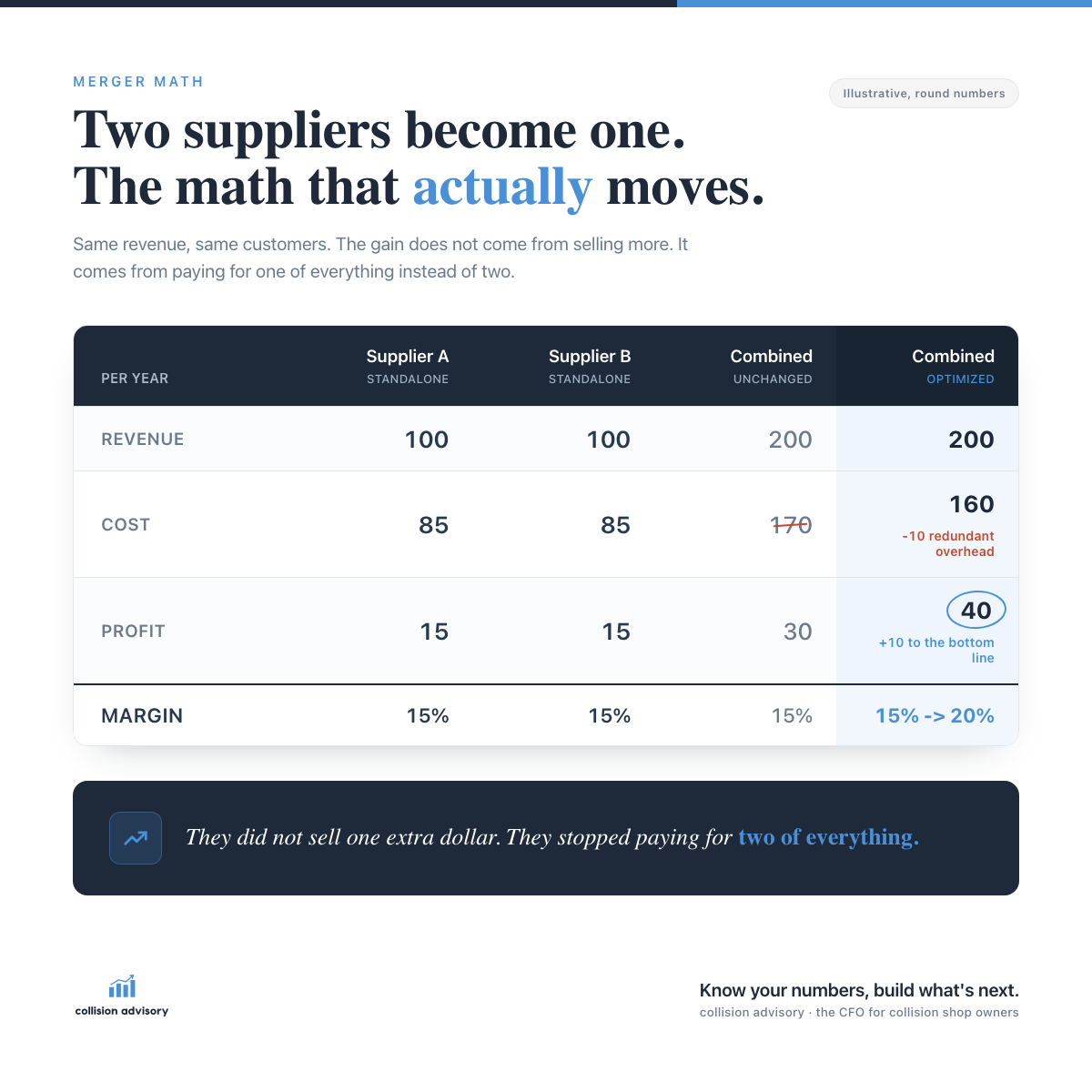
Now run it the way these deals get run. Some of that cost was being paid twice. Two marketing teams, two back offices, two executive groups, two finance departments. You don't need two of each anymore. Over time, a chunk of that duplicate cost comes out. Call it 10. The revenue doesn't move, it's still 200, but cost drops to 160 and profit steps up from 30 to 40. They didn't sell one extra dollar. They stopped paying for some of what they had been buying twice.
That is the engine under most of these deals. Not more sales. Less duplicated cost.
The savings is real, and it has an owner
That new profit is not imaginary. It's real money, and the moment it exists, it belongs to someone. The question worth asking is simple. Who?
There are only a few places it can go. It can be handed back to customers as lower prices. It can be kept by the company as fatter margin. It can be passed up to the people who financed the deal, the private equity funds and shareholders who backed it expecting exactly this outcome. In most consolidations, the last two win long before the first one does. The savings was the point of the deal. Giving it away would defeat the purpose.
Leverage decides whether any of it reaches you
Whether a customer ever sees a nickel of merger savings comes down to leverage. When the customer has real alternatives and can credibly walk, the supplier shares some savings to keep the business. When the customer has nowhere else to go, the supplier keeps it. That's not villainy. It's how pricing power works.
Now look at where a single collision shop sits in that picture. Your suppliers are getting larger and fewer. Your options on diagnostics, calibration, and paint are consolidating into a shorter list. That's the exact setup where the savings stays upstream. So when you read one of these merger headlines, the honest expectation isn't a lower invoice. It's a supplier that just picked up a little more pricing power over you.
What this means for your shop
You can't stop the industry from consolidating. You can watch your own position inside it, and that part is in your control.
Know what you actually spend, by supplier and by category. Most shops can't say within a few thousand dollars what they pay a year for scanning and calibration, or how their paint cost per repair-hour has moved. If you can't measure it, you can't negotiate it.
Know where you have leverage and where you don't. Volume, contract timing, a credible second source, being a reference account. Those are the things that put weight on your side of the table. If you have none of them, that's worth knowing before your next renewal, not after.
And watch the trend, not the single bill. Price to a shop rarely jumps. It drifts, and consolidation is one of the quiet forces behind the drift. The owners who see it coming plan around it. The ones who don't just feel the squeeze and can't name the cause.
The headline says the industry is getting more efficient. It probably is. Just be clear about who that efficiency is built to pay.
Know your numbers, build what's next.
If you want this kind of operator finance read every week, my email is here: collisionadvisory.com/subscribe.

Doug Higgins
Founder, Collision Advisory
Former CFO at Kroger's Midwest Division and CEO of TAG Auto Group. Doug brings institutional financial rigor to the collision repair industry.
Connect on LinkedInMore from M&A
Boyd Q1 2026: The M&A read
Boyd's CEO told investors that the opportunity to consolidate the space is as good as it's ever been. The pipeline language a consolidator uses about deal flow is the cleanest tell for what the market for sellers looks like 12 months out. The M&A read for indie operators thinking about a sale in the next 24 months.
What Consolidators Actually Look At During Due Diligence
Boyd Group just closed a $1.3 billion deal. Here are the five things a buyer's diligence team actually looks at when they walk in your door, and what it means for your shop whether you're selling or not.
What the 2025 Collision Repair M&A Data Means If You Own 1-5 Shops
Focus Advisors just published their 2025 M&A Year in Review. Here's what the data actually means if you own one to five shops.